Here’s a freight car I built straight out of the box with no additions. This HO scale CB&Q, 50-foot, single-sheathed automobile car is an old Speedwitch media kit. I pretty much followed the instructions to the letter for the build.
The car was weathered with various washes of Testors Model Master paints with a final dry brushing of the base color. Sometimes it’s fun not to think and just build.
Charlie Duckworth joins the blog with his build summary of a classic Sunshine Models resin box car kit. Click on any image to review a larger size. Here’s Charlie’s report.
History
The Missouri Pacific and its subsidiaries purchased or built some 4,439 Howe Truss boxcars. The cars had a capacity of 2,926 cubic feet and used a Murphy radial roof. All of the 2,750 MP 46000-48749 series and the first batch of 1,569 cars for the International-Great Northern 6201-6950 were built with indented Murphy ends. These cars were built in 1926 by ACF with a few coming from Standard Steel Car Company. The I-GN 9401-9900 group was built by ACF in 1927 and used the indented Dreadnaught ends. The final 100 cars used Creco door hardware, whereas, the rest of the fleet used Camel hardware. Prototype painting was initially boxcar red with black underframe and trucks with the car body shade being modified over time to a medium brown. Stenciling was white.
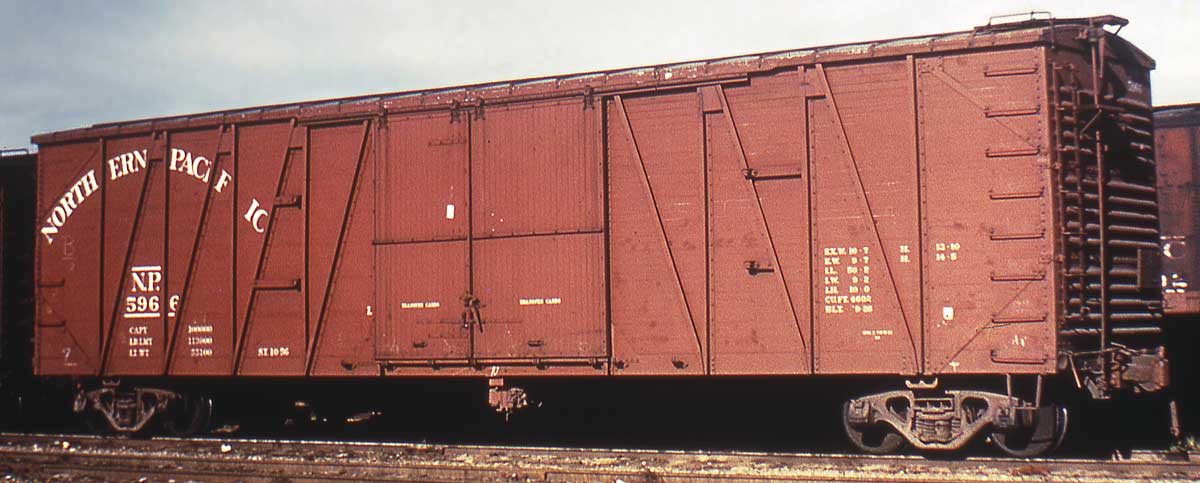
Northern Pacific 5966, a 50-foot, single sheathed automobile box car built in 1926. Photo from the Jim Gerstley Collection, courtesy of Dan Smith.
Bill Welch is back with more tales from his workbench. Click on any image here to review a larger size. Here’s his latest report.
As a part of building freight car models, I enjoy collecting photos for car kits I already have or hope will be produced. I have found several photos of the big 50-foot Northern Pacific single sheathed cars that I used to aid in building an HO scale kit of the car offered by Speedwitch Media. After I had finished my assembly, I realized I have a colour photo from circa 1956 on my computer showing the galvanized roof panels devoid of any paint except for some misting of overspray along its edge from the last time the body had been painted. The roof ribs did appear to be painted or perhaps coated with a “freight car red” car cement. I decided I wanted to try and recreate this appearance, which meant I needed to mask the roof, a chore made more tedious because I had already glued the Running Board System in place. Oh joy!
I present for you a fine illustration of not paying attention to what you’re doing. In this example, I forgot to follow the measure twice cut once rule.
I was working on a build of Resin Car Works Kit 1.04. I painted the grey and masked that area, then painted the rest of the tank red. The lower tank, frame and trucks were painted separately then the car was assembled. When I went to place the decals, they did not fit.
You did read that correctly. The decals did not fit.
I had made the grey area too wide. This grey band shouldn’t be any more than the width of the platform. I would have known this if I had test fit the decals to the area before masking the car. So I lost some time on this build. I’ll just repaint the car in black, which is appropriate for my era.
It’s a lesson learned on this tank car paint job. I know I’ll get it right the next time!