Charlie Duckworth shares a classic resin freight car kit build.
History
The SLSF 145550-144749 series were at one time the third largest block of boxcars on the road, with 1200 installed. Originally built as automobile boxcars in 1923, they had 7-foot wide door openings with a Samson radial roof. The ends had 7/8 outward facing, Murphy corrugated steel stampings. By the 1930’s, the 7-foot doors were too small for automobile loading and the cars were placed in general service. The railroad listed 1,024 of these cars in the 1940 ORER as general service box cars (XM). There are no listings in this number series by the 1956 ORER.
Charlie Duckworth returns with another interesting build summery.
History
In 1921, American Car & Foundry (AC&F) built 500 single sheathed boxcars for the New Orleans, Texas & Mexico Railroad. These cars had peaked roofs and wood ends with steel bracing. The Missouri Pacific added these cars to their boxcar fleet when they acquired the Gulf Coast Lines railroads in January 1925. The cars were repainted into the parent company’s standard with the revised ‘Mopac buzz saw’ (the revision being the addition of ‘Lines’ to the logo) now appearing on the sides of the newly acquired GCL and I-GN equipment for the first time.
Although the cars only had 8-foot high interiors, they lasted quite a long time with 451 still on the roster in 1948. Due to a shortage of cabooses on the Mopac during WW2, 90 of these boxcars were converted to war emergency cabooses with personnel doors and windows added to the carbody. After the war, many of these cabooses were transferred to maintenance of way service.
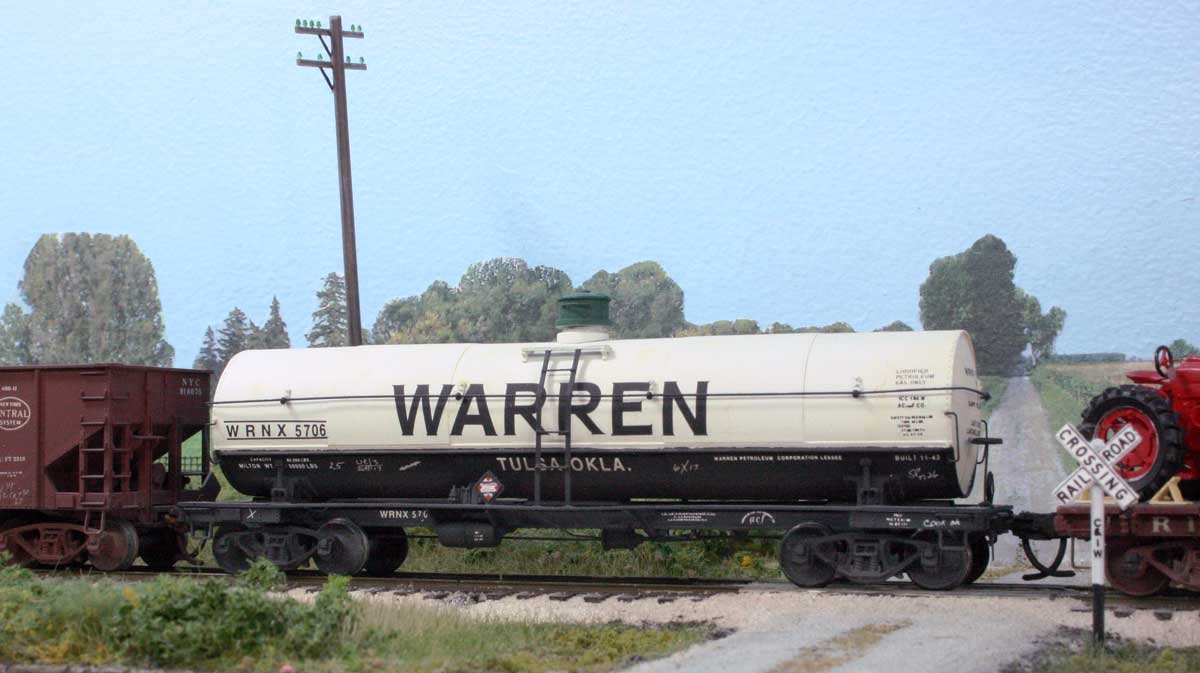
A tank car model with components from Tichy and Athearn reflects a popular prototype.
Here are a couple more modified models that are in service on the railroad. The Warren tank car is a shortened Athearn chemical tank on a lengthened Tichy frame. The cuts in the Athearn tank are covered with 0.005-inch sheet styrene to represent the jacket over the insulation. The model has the rough overall dimensions of an AC&F Type 27 Class 105 propane 10.5K gallon tank car. The bonnet is a resin casting that I did maybe two decades ago and has been noted several times on Tony Thompson’s blog. The decals are from Sunshine Models but others are available.
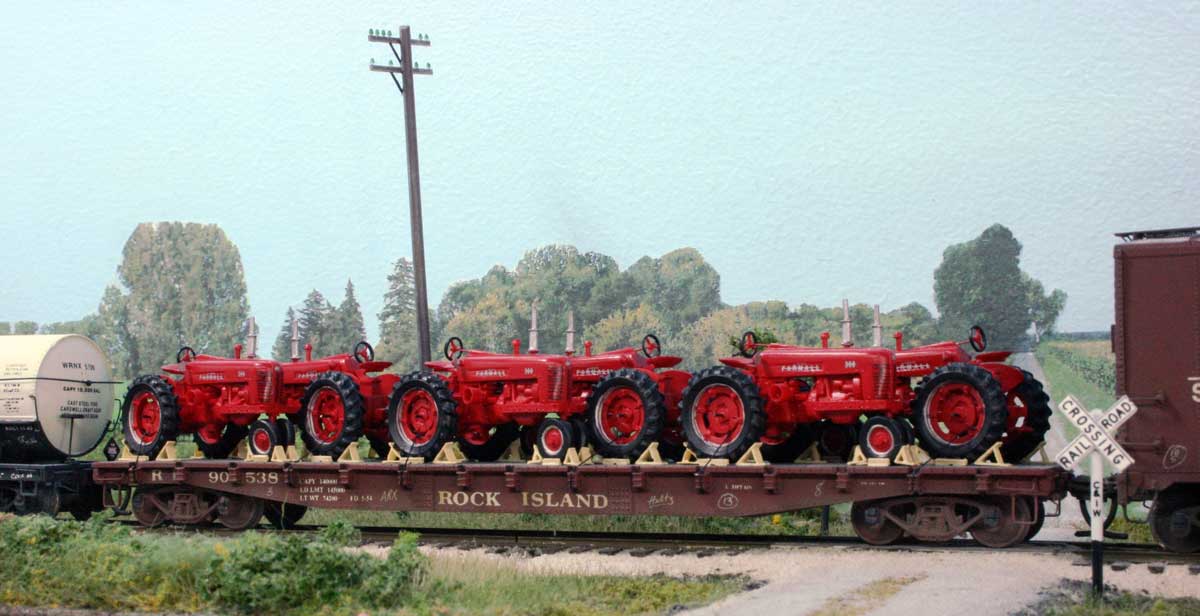
This flat car is actually two Red Caboose flat car models spliced together just as the Rock Island had done. Take a flat car, cut it in half, add new steel in-between and “presto!,” a longer flat car. The splice plates were done with styrene with rivets harvested from an Athearn gondola. Today we would use Archer rivet decals.
The decal lettering were extra bits from other used sets. The deck was widened with styrene matching the existing deck thickness and then distressed. The stake pockets came with the Red Caboose kits.
The load is six Farmall 300 series tractors which were produced from 1954 to 1956, which falls right into my late August 1955 time period. These tractors are resin castings from a pattern done for Martin Lofton at Sunshine Models, but were never issued.
A recent discussion on the Steam Era Freight Car YahooGroup centered on an interesting Waterloo, Cedar Falls & Northern (WCF&N) flat car. Here’s one way to model a similar prototype.