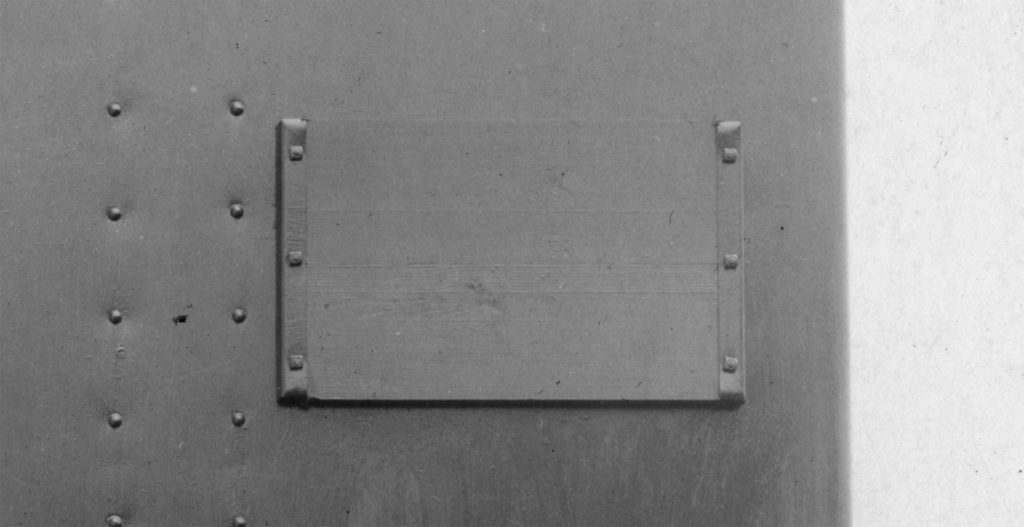
In our last blog post, I used the term tack boards to describe a detail that I added to a model. Guy Wilber sent a note correcting my terminology. These are placard boards. Guy sent the following prototype documentation.
Placard boards first became a necessity for applying placards on freight cars transporting explosives or other dangerous commodities as required by regulations first issued by the American Railway Association (A. R. A.) in 1905.
Shippers also utilized placard boards to attach various commodity cards including, “UNLOAD FROM THIS SIDE,” “FRAGILE,” “AUTOMOBILES,” etc. Early freight cars of all wood construction allowed for easy attachment of placards by several methods including tacking, gluing, pasting, or varnishing the placards to car ends and sides. As all-steel ends and all-steel construction became widespread for freight cars the solution for applying placards was a separate board constructed of soft wood with a steel frame and riveted to the car.
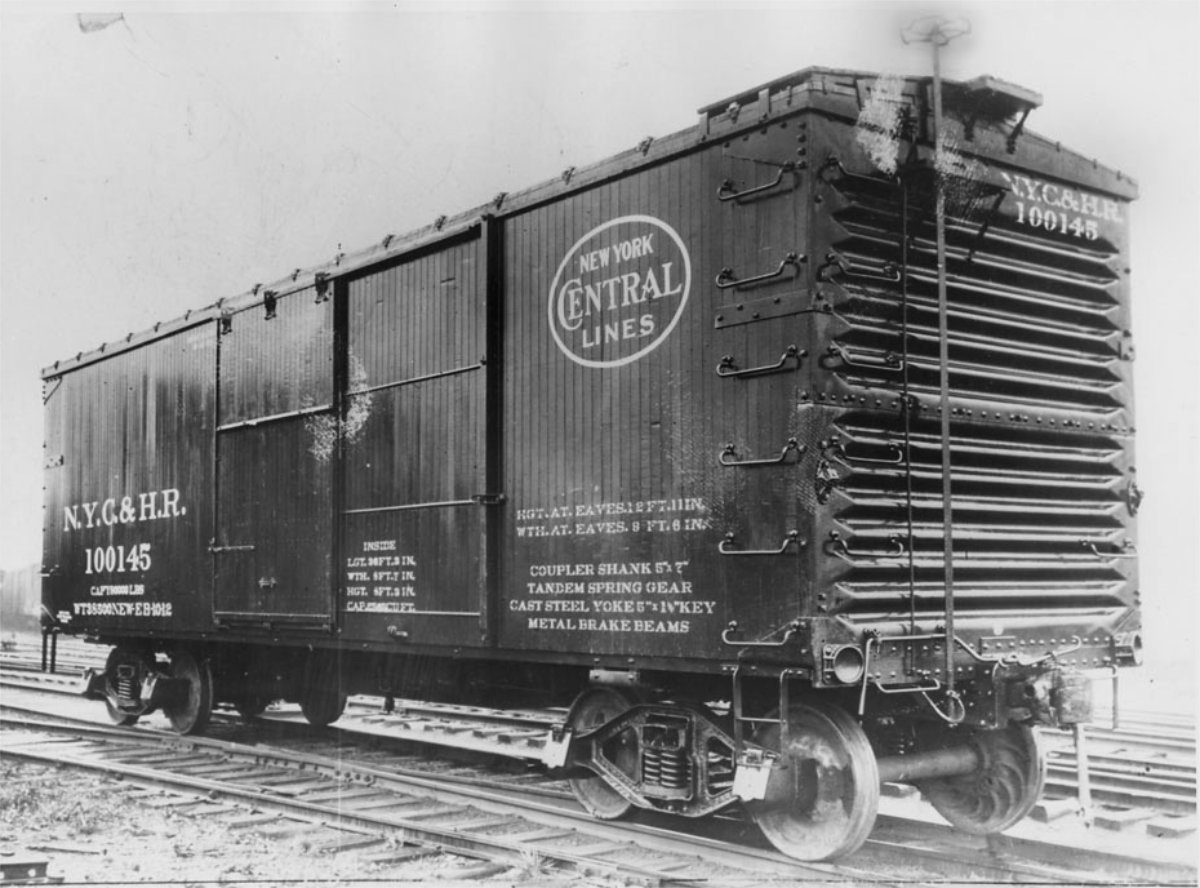
This NYC&HR box car in the image above was originally built by AC&F in 1907. The car is documented with a new fishbelly underframe and steel ends with an October 1912 weigh date stencil. Notice there isn’t a placard board installed on the steel end.
In April of 1905 the A.R.A. appointed a special committee, “to consider the question of the advisability of adopting uniform regulations covering the transportation of explosives and other dangerous articles.” The association adopted the first regulations for shipping explosives on October 23, 1905. The bulk of the regulations mimicked those from the Pennsylvania Railroad’s General Notice No. 174 “Transportation of Explosives” originally issued on September 5, 1899.
An early survey conducted by the A. R. A. committee received 134 replies from railroads of which 85 (63%) were currently using the Pennsylvania regulations for guidance in shipping explosives. By April 24, 1906, 183 railroad companies had adopted the regulations (including amendments) and 2,000 copies had been distributed. The A.R.A. publication contained instructions for placarding cars transporting explosives “on both sides and both ends” though no specifics were listed for the dimensions of placards, nor their position on ends or sides. The rules for placarding cars from within the regulations included:
PLACARDING OF CARS AND CERTIFICATION OF CONTENTS.
No. 20. Every car containing Common Black Powder, High Explosives, Smokeless Powders, Fulminates or Great Gun Ammunition, in any quantity, must be plainly carded on both sides and both ends “EXPLOSIVES —HANDLE CAREFULLY-KEEP FIRE AWAY.”
In accordance with a notice issued on October 29, 1906, the Bureau for the Safe Transportation of Explosives and Other Dangerous Articles was duly organized at New York City on November 21, 1906. The Bureau’s duties included; oversight of the railroads, manufacturers, and the adherence of shippers of explosives to the regulations. The Bureau became a conduit to the A.R.A. for the promulgation and revision of rules and assurance that manufacturers of explosives adhered to standards for packaging, marking, and secure loading of products.
Prior to the issuance of the amended 1908 A.R.A. Regulations, the passage of the “Act to Promote the Safe Transportation in Interstate Commerce of Explosives and Other Dangerous Articles” approved May 30, 1908, granted the Interstate Commerce Commission “power to formulate regulations for the safe transportation of explosives, which shall be binding upon all common carriers engaged in interstate or foreign commerce which transport explosives by land.” Following an amendment of the Act on March 4, 1909, the A.R.A. Regulations were issued under the new title, “Regulations for the Transportation of Explosives and Other Dangerous Articles by Freight and by Express and Specifications for Shipping Containers,” and took effect on April 15, 1910. The regulations for other dangerous articles were still governed by the A.R.A. until the 1914 revision of the I.C.C publication.
In 1909, The Arbitration Committee of the Master Car Builders’ Association added Interchange Rule No. 41 to clarify the types of cards which were required within the I.C.C. regulations. The rule, subsequently renumbered No. 45 in 1911, read: Rule 45, Paragraph (2) Special Cards: Required by the Regulations for the Transportation of Explosives formulated by the Interstate Commerce Commission and the Regulations for the Transportation of Inflammable Articles and Acids prescribed by the American Railway Association. They shall be used, be of the text and size described, and be attached to cars as prescribed by said regulations.
In order to expedite the application of placards to cars used in interchange, The Master Car Builders adopted as “recommended practice” the specifications for placard boards approve (via letter ballot) on September 2, 1914.
PLACARD BOARDS FOR HOUSE CARS. “RECOMMENDED PRACTICE”.
The space available for placards each side of car. House cars with sufficient space available on wood siding, or exposed lining, should have a rectangular space, painted black, on each side and each end. Other house cars should be provided with placard boards, made of soft wood, not less than 16 by 24 by 1 in. The vertical edge should be reinforced with metal protection, and the bolts fastening the boards to the car should be not less than six in number, and should pass through the metal reinforcing pieces, three through each. The boards may be made of more than one piece and should then be tongued and grooved. The distance from the floor line of car to bottom of board should be not less than 4 ft. 6 in. Routing boards, preferably the same size as the placard boards described, should be placed on the side of the car, as near as possible to the door seal.
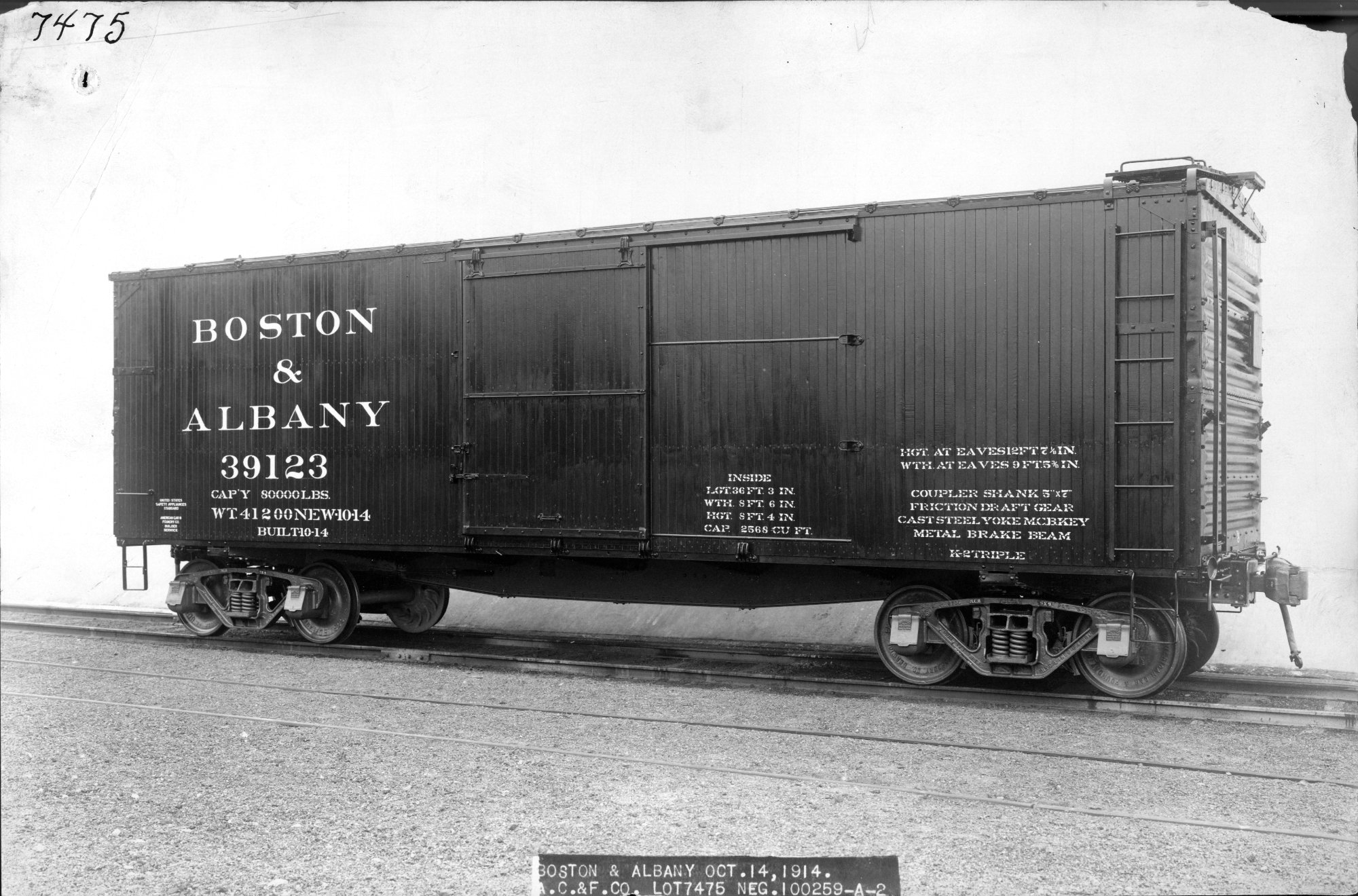
The AC&F builder image above of Boston & Albany 39123 captures a new box car with steel ends and placard boards in place.
The American Railway Association’s Arbitration Committee added Interchange Rule No. 49 in 1921 requiring all car owners to equip house cars with placard boards, therein referred to as, “cardboards” which was an interchangeable term with “placard board.” Interchange Rule No. 49, Paragraph (3) All steel cars not equipped with cardboards for special explosive and other placards, as required by the I.C.C. same to be located on side doors and both ends of car. Size to be not less than 12 by 12 in.
Rule 49 was revised in 1927 to match the size of placard boards as listed within the Supplement to the Manual of Recommended and Standard Practice. The text was identical to 1921 rule, but the last sentence which was modified to read: “Size to be not less than 16″ x 24”. In 1937, The A. A. R.’s “Supplement to the Manual” was revised for Placard Boards changing the thickness requirement from 1-1/4 in. to, “no less than 25/32”.
Placards
Placards were modified several times throughout the next several years and should be examined for specifics corresponding to your modeling era. The two examples (below) are from the 1914 ICC Regulations. Placards were rectangular (12” x 14”), diamonds (10-3/4” or 5-3/4” on sides), and square (5”) among others. A couple of examples follow.
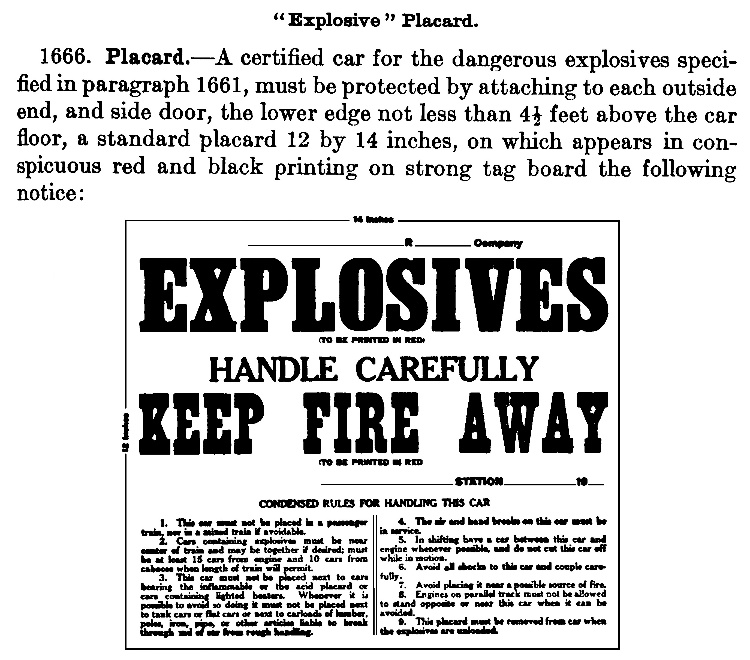
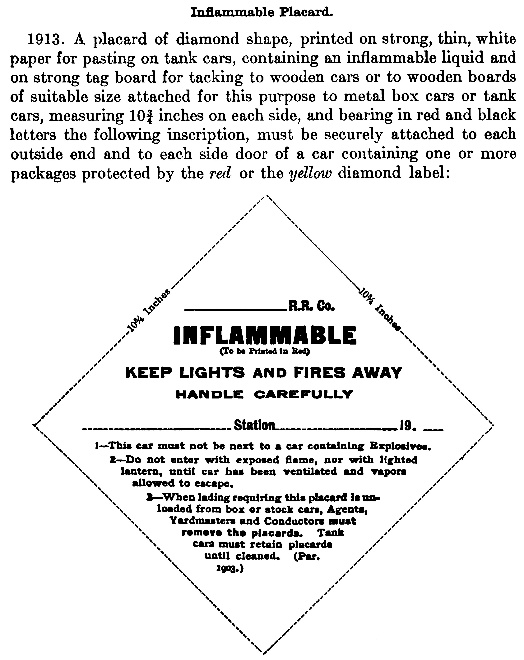
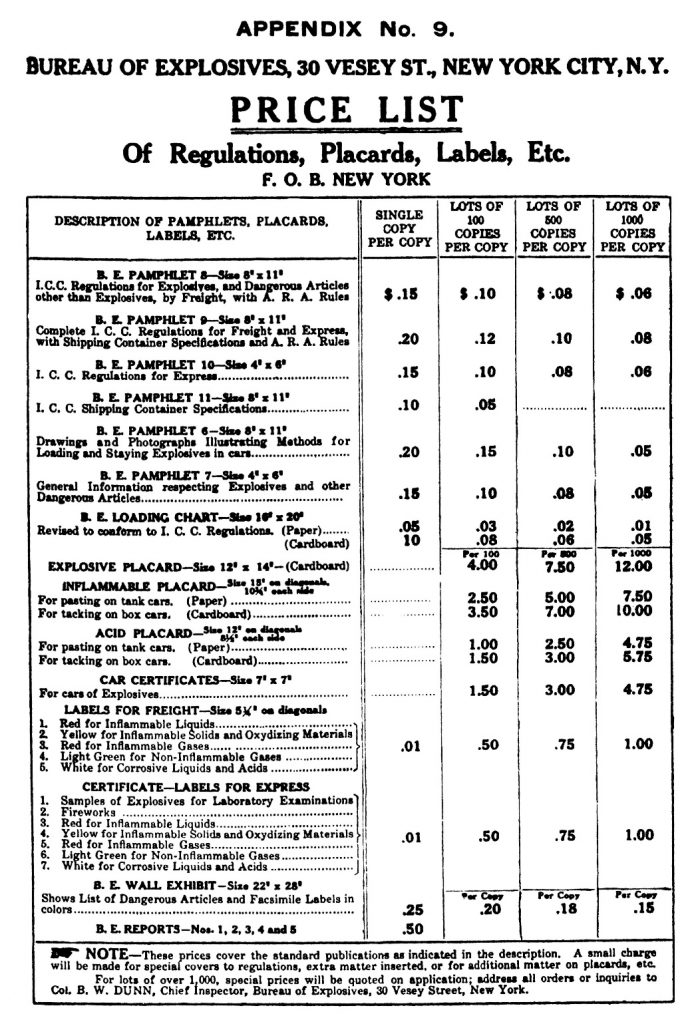
A 1909 price list above calls out the background and lettering colors for placards and package labels specific to explosives (red), inflammable solids and oxidizing materials (yellow), inflammable gases (red), non-inflammable liquids, non-inflammable gases (light green), and corrosive liquids and acids (white).
In 1913, the Master Cars Builders’ Association’s Arbitration Committee added Rule 36 to the Interchange Rules; Rule 36, paragraph 2. Special Cards: Required by the Regulations for the Transportation of Explosives formulated by the Interstate Commerce Commission and the Regulations for the Transportation of Inflammable Articles and Acids prescribed by the American Railway Association. They shall be used, be of the text and size described, and be attached to cars as prescribed by said regulations.
The rule was modified by the Arbitration Committee in 1916; Rule 36, paragraph (3). Special Placards. These shall be such as are required by the “Interstate Commerce Commission Regulations for the Transportation of Explosives and Other Dangerous Articles by Freight and by Express,” and are to be of the size as therein described. They shall be used, be of the text and be attached to the cars as prescribed by said regulations. Missing placards or certificates on cars containing explosives and other dangerous articles must be replaced. Placards and certificates on empty cars, except inflammable placards on tank cars, must be removed.
Additional uses
Placard Boards were also utilized for displaying various placards from shippers referred to as “Commodity Cards” within Interchange Rule No. 36 which governed the placement of advertising on freight cars; “Commodity Cards. Shipper may attach not to exceed one per side and per end of car, to indicate “Eggs”, “Glass”, “Handle Carefully”, “Fragile,” etc. In addition, name and location of shipper only, in letters not to exceed one-half inch in any dimension, may be printed thereon. They must not be secured with paste or glue, except that commodity cards required on tank cars may be pasted, glued or otherwise secured. To be of cardboard, maximum dimensions 12 inches by 12 inches without picture, trademark, red printing or red background.”
Rule 49, paragraph (d) was added in 1953 requiring placard boards on refrigerator cars for the application of placards warning of toxic gases from heaters. Rule 49, paragraph (d); All steel box cars and steel sheathed refrigerator cars not equipped with card boards for special explosive and other placards, as required by the I.C.C. Same to be located on side doors and both ends of car. This requirement also applied to ends of box and refrigerator cars having metal ends and wooden sides. (On refrigerator cars, they shall be located adjacent to side doors but must not be concealed when doors are in open position.) Size not to be less than 16 x 24 inches.
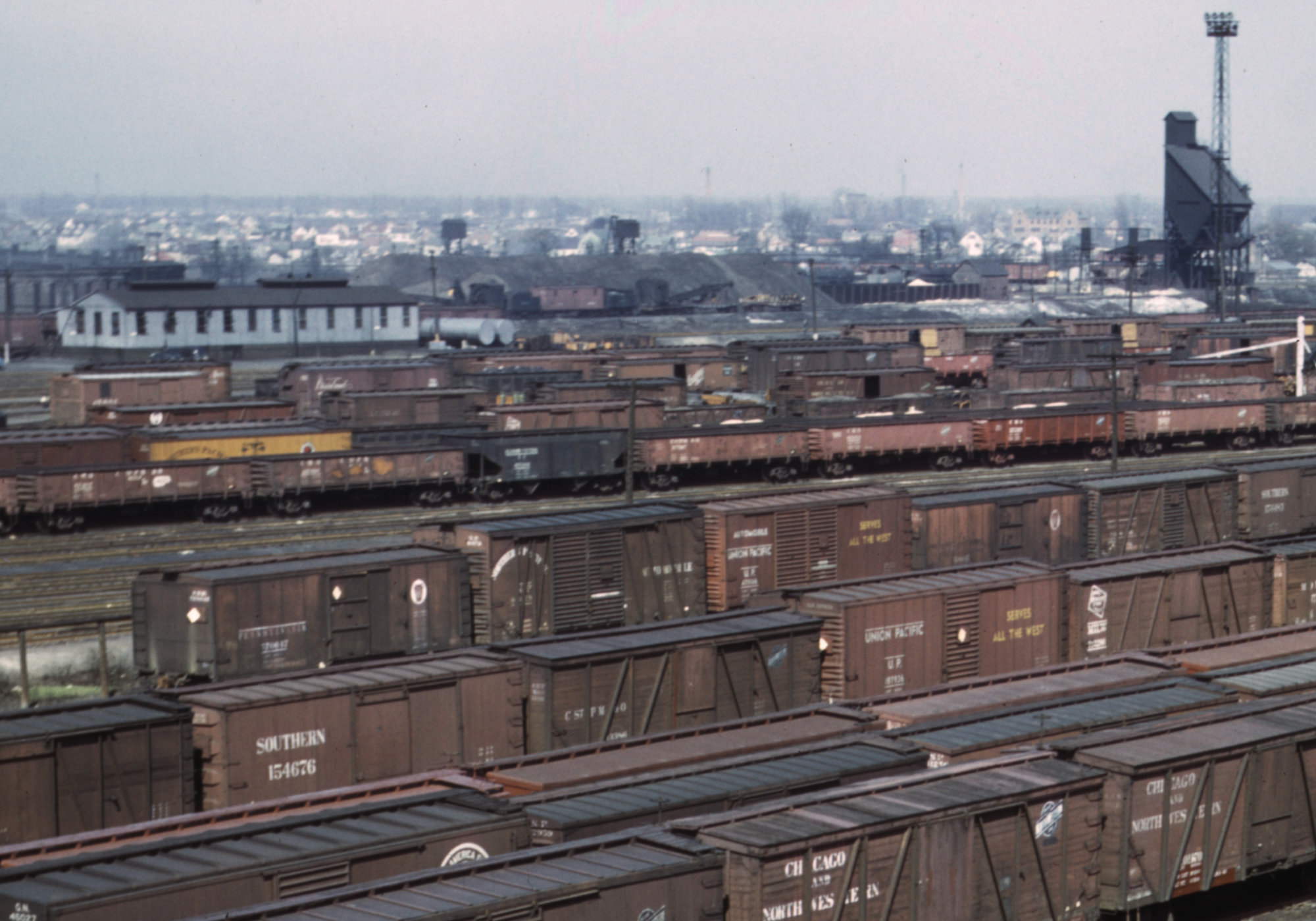
Two box cars have placards applied to sides and ends in an edit of a 1943 Jack Delano photograph above. A Pennsylvania Railroad car at the left and a Union Pacific car right of center have had placards mounted on an angle.
In 1953, the AAR’s Car Construction Committee addressed complaints made regarding the accessibility of routing cardboards when box type cars were on open tracks away from raised platforms. The present location of placard boards had been required by the Bureau of Explosives to be not less than 4 ft., 6 in. from floor of car to bottom of board. The Bureau of Explosives removed the height limitation and, therefore, in the interest of safety and convenience of placard application and removal, your Committee recommended the following locations as being more readily accessible.
Ends of Car:
(a) House and Refrigerator Cars. On right side when facing end of car and with lower edge not over 2 ft. 6 in. above floor level.
Sides of Car:
(a) House Cars. On door, right side when facing side of car, lower edge not over 22 in. above floor level, and with routing cardboard on door to left of placard board and with lower edge of both boards in line.
(b) Refrigerator Cars. On side to left of door, but not concealed when doors are in open position, and with lower edge not over 22 in. above floor level (see Rule 49d). Routing cardboard to be located directly under placard board (see Rule 49c).
The proposals were adopted (via letter ballot) and made effective, March 1, 1954
I thank Guy Wilber for sharing his placard board information and prototype details. It’s a very interesting evolution. Tony Thompson has covered placards on his blog with many examples of signage that has been posted on various freight cars. Here’s a “placards” search result that gathers many of his posts.
Subscribe to the Resin Car Works blog so you don’t miss a new model announcement. Add your email address to the Subscribe function at the bottom of the page.
Questions and comments can be posted below. Please follow the instructions so your comment can be posted. All comments are reviewed and approved before they appear. Share the blog link with other model railroaders.
Great article Thanks for sharing.
Mark
As a result, early, non-standardize placards began to appear in the late 1800s, with the Pennsylvania Railroad being one of the early pioneers.
Due to the growing number of catastrophes, in 1906 the President of the Pennsylvania Railroad urged carriers to adopt regulations to promote the safe transportation of explosives. The Bureau of Explosives (BOE) was created under the American Railway Association that same year.
Inflammable vs. Flammable
Both flammable and inflammable mean “capable of being easily ignited and of burning quickly”.
In the 1920s the National Fire Protection Association urged Americans to start using the word flammable to avoid confusion and prevent fires because they thought people may mistake inflammable as meaning not being able to burn.
Sometime in the late 1950s the ICC regulations shifted to the use of “Flammable” on placards.