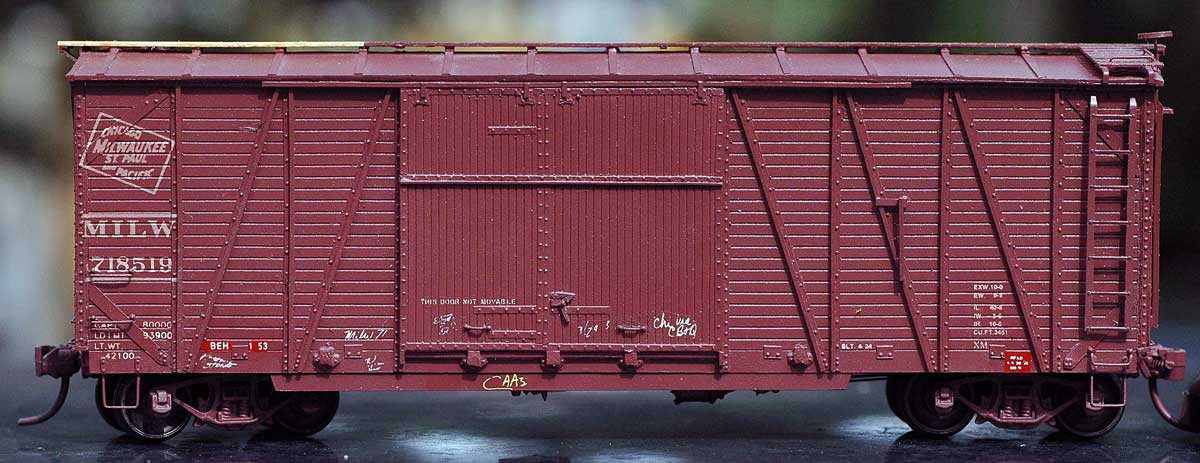
A Weathering Rookie Tries PanPastels & Colored Pencils

201509welch_MILWxa_model1

Bill Welch returns to the RCW blog with a beginner perspective on Pan Pastels for weathering freight cars.

I thought I would describe my first weathering experience primarily using PanPastels (PP) with a little assist from Prismacolor Colored pencils. The subject model was built 19 to 20 years ago from a Funaro & Camerlengo kit, probably purchased from The RPI Hobby Shop in Troy, NY. I used a photo from “The Bob Charles Collection” at the NMRA Library to guide me in detailing and decaling. It is painted with Accuflex paint using my Binks “Wren” airbrush. The decals I am pretty sure are Champ and I very likely pieced together the Dimensional Data with individual numbers to match this car. Continue reading A Weathering Rookie Tries PanPastels & Colored Pencils

Wabash Automobile boxcars

wab_47440_xa_Model1_web
Speedwitch Media Wabash Automobile boxcar.

Charlie Duckworth returns with comments on a pair of interesting resin kit builds.

History
The Wabash had a large fleet of single-sheathed automobile boxcars starting in the 1920’s and running these well into the 1950’s. The designs were basically standardized with radial roofs, wood or steel doors, and Murphy or Dreadnaught ends. These were tall cars having 10-foot high interiors. Wabash 46000-46999 had 5/5/5 Murphy ends. The 47000-47999 had 3/3/3 Dreadnaught ends. Another group numbered 17000-17299 had Dreadnaught automobile end doors. For prototype photos and additional history, consult page 80 in ‘Focus on Freight Cars Volume One: Single Sheathed Box & Automobile Cars’ by Richard Hendrickson.

Continue reading Wabash Automobile boxcars

Storzek Soo Line boxcar converted to a NOT&M boxcar

notm_xm_action_web

Charlie Duckworth returns with another interesting build summery.

History
In 1921, American Car & Foundry (AC&F) built 500 single sheathed boxcars for the New Orleans, Texas & Mexico Railroad. These cars had peaked roofs and wood ends with steel bracing. The Missouri Pacific added these cars to their boxcar fleet when they acquired the Gulf Coast Lines railroads in January 1925. The cars were repainted into the parent company’s standard with the revised ‘Mopac buzz saw’ (the revision being the addition of ‘Lines’ to the logo) now appearing on the sides of the newly acquired GCL and I-GN equipment for the first time.

Although the cars only had 8-foot high interiors, they lasted quite a long time with 451 still on the roster in 1948. Due to a shortage of cabooses on the Mopac during WW2, 90 of these boxcars were converted to war emergency cabooses with personnel doors and windows added to the carbody. After the war, many of these cabooses were transferred to maintenance of way service.

Continue reading Storzek Soo Line boxcar converted to a NOT&M boxcar

Helper Service – Streator pt 1

Helping others plan their layout is a fun activity which doesn’t cost anything. At least it doesn’t cost me anything; some of my friends though might have a different opinion. I’m currently helping with a layout concept based on the Wabash Railroad’s Streator branch. This was a line which originated from a small yard on Wabash’s Chicago/Decatur main line at Forrest, Illinois, and headed northwest to Streator Illinois.

wab_StreatorBr

Continue reading Helper Service – Streator pt 1