Charlie Duckworth builds a pair of Rock Island automobile box cars. Click on any image here to view a larger size.
Ron Von Werder, owner of Rocket Express, offers two Rock Island (RI) automobile boxcars. Both HO scale kits are flat castings and assemble easily. I prefer using Westerfield’s RI decals for the reporting marks and numbers as his artwork looks closer to the Rock Island prototype lettering than what is supplied in the kits.
We have another guest post this week. Eric Hansmann illustrates a couple of techniques to ease installing details onto freight car models.
As prototype model railroaders, we often push our efforts to include many prototype detail elements on our freight cars. In reviewing the image above, there are several common elements that are typical of many kits. Let’s take a look at one of the smaller components and how to ease the installation process. Click on any image here to review a larger size.
A tank car model with components from Tichy and Athearn reflects a popular prototype.
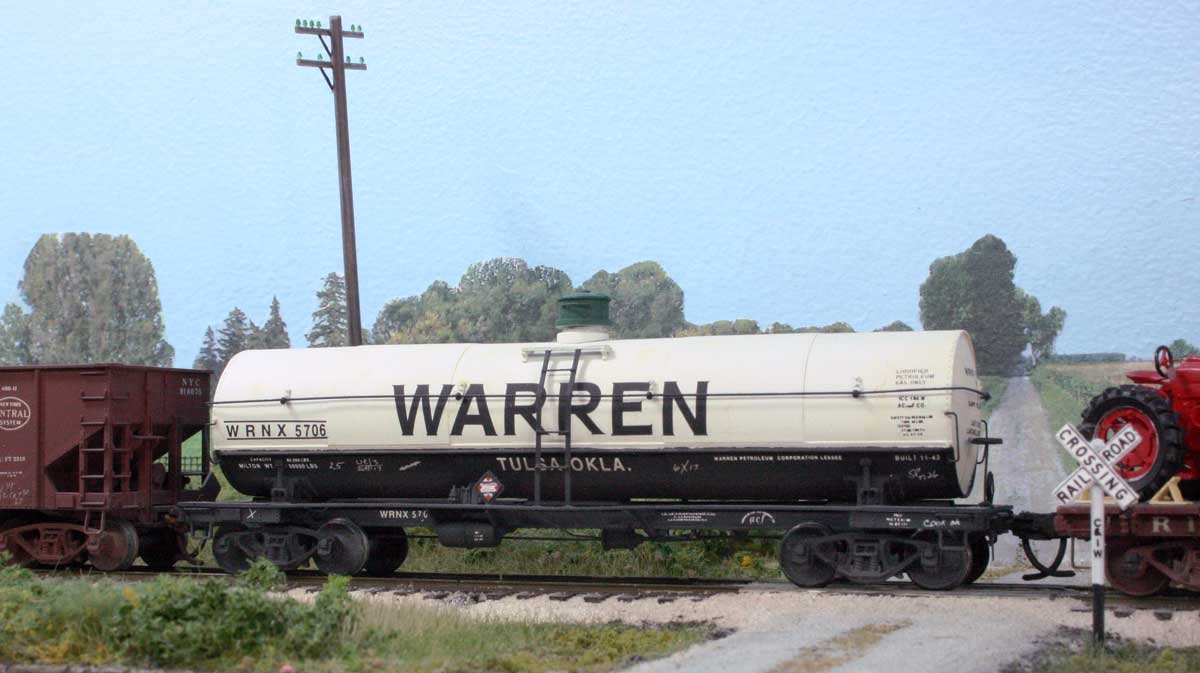
Here are a couple more modified models that are in service on the railroad. The Warren tank car is a shortened Athearn chemical tank on a lengthened Tichy frame. The cuts in the Athearn tank are covered with 0.005-inch sheet styrene to represent the jacket over the insulation. The model has the rough overall dimensions of an AC&F Type 27 Class 105 propane 10.5K gallon tank car. The bonnet is a resin casting that I did maybe two decades ago and has been noted several times on Tony Thompson’s blog. The decals are from Sunshine Models but others are available.
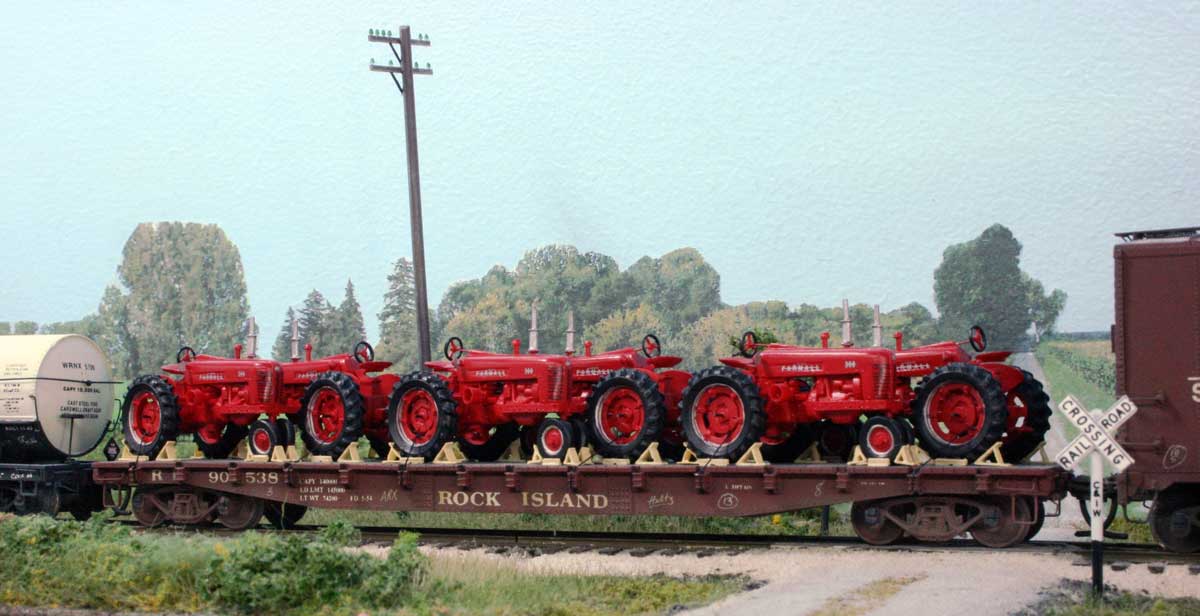
This flat car is actually two Red Caboose flat car models spliced together just as the Rock Island had done. Take a flat car, cut it in half, add new steel in-between and “presto!,” a longer flat car. The splice plates were done with styrene with rivets harvested from an Athearn gondola. Today we would use Archer rivet decals.
The decal lettering were extra bits from other used sets. The deck was widened with styrene matching the existing deck thickness and then distressed. The stake pockets came with the Red Caboose kits.
The load is six Farmall 300 series tractors which were produced from 1954 to 1956, which falls right into my late August 1955 time period. These tractors are resin castings from a pattern done for Martin Lofton at Sunshine Models, but were never issued.
A recent discussion on the Steam Era Freight Car YahooGroup centered on an interesting Waterloo, Cedar Falls & Northern (WCF&N) flat car. Here’s one way to model a similar prototype.
I present for you a fine illustration of not paying attention to what you’re doing. In this example, I forgot to follow the measure twice cut once rule.
I was working on a build of Resin Car Works Kit 1.04. I painted the grey and masked that area, then painted the rest of the tank red. The lower tank, frame and trucks were painted separately then the car was assembled. When I went to place the decals, they did not fit.
You did read that correctly. The decals did not fit.
I had made the grey area too wide. This grey band shouldn’t be any more than the width of the platform. I would have known this if I had test fit the decals to the area before masking the car. So I lost some time on this build. I’ll just repaint the car in black, which is appropriate for my era.
It’s a lesson learned on this tank car paint job. I know I’ll get it right the next time!