Category Archives: Details

Paint failure

Farm Security Administration – Office of War Information Collection 12002-14

Just before Christmas, discussion on the Steam Era Freight Cars YahooGroup was focused on box car roof paint failure. Many felt the overall effect was interesting, but far less common in the steam era due to more accumulation of soot on freight cars. Nonetheless, paint does fail, most noticeably on galvanized metal roofs. The above image is a portion of a 1943 Jack Delano photograph of the Milwaukee Railroad freight house in Galewood, IL. Of the nine box cars in the edited image, three of the roofs show signs of paint failure. The most apparent example can be seen on a car in the second row and second from the left. The two cars in the front row on the right side also show some paint failure.

We invited modelers to share images and techniques to inspire others to add this detail to a few of their freight cars.

Continue reading Paint failure

Creating Eucalyptus trees

201511hall_lead

And now for something completely different! Peter Hall needed trees to set the distinct scenes on his California layout. Read along to discover his techniques. Click on any image here to review a larger size.

If you model prototype railroading in California, there is a good chance you will need to create good-looking Eucalyptus trees. I model the Southern Pacific Coast Line, and they seem to be everywhere, in groves of many trees or sometimes in lines along the right-of-way or a road.

Continue reading Creating Eucalyptus trees

“Like Things at Like Times:” Building Two Kits at Once – Pt 1

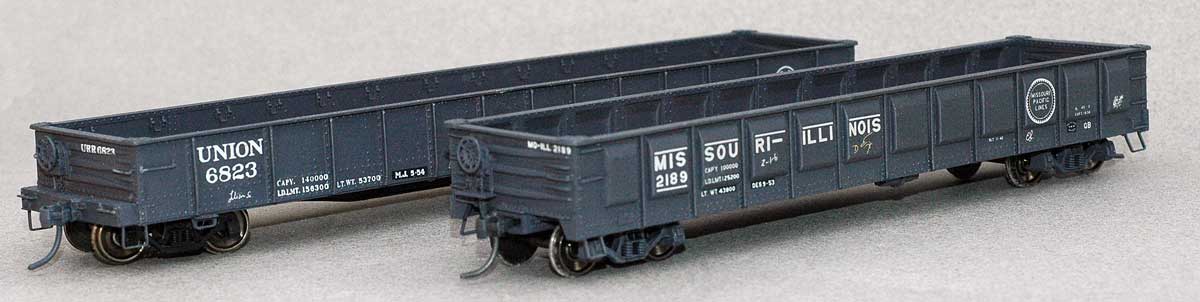
welch2gons_intro

Bill Welch returns with a double treat. Click on any image here to review a larger size.

For years now whenever I can, I try to build two models at the same time. There are many similar steps for each build, such as washing parts, removing flash, drilling holes, mounting brake systems, installing grab irons, and more. Adding work time to an extra model on the bench seems to reduce the overall build time for two models.

Resin kit building usually involves a lot of hole drilling. I like to use a sharp object to create a starting point for the drill bit so that it will not wander. Mine is different from the one pictured in that link. When drilling holes for sill steps, I like to make a starter hole with a smaller bit before I drill the final hole with a #75 bit. It is just as easy to do this on two cars at once as it is to do it on one. Body motions like changing bits require time, so doing two models at one time can actually save time. My modeling/railroad historian/general raconteur friend Dr. Frank Peacock, DDS, observes that in dentistry this approach is termed “like things at like times.” As my description with the two Funaro & Camerlengo gondola kits will demonstrate, the two models only need to be similar, not identical.

Continue reading “Like Things at Like Times:” Building Two Kits at Once – Pt 1

Rocket Express 40 and 50-foot Rock Island Automobile boxcars

ri_xa_40ftcomplete1

Charlie Duckworth builds a pair of Rock Island automobile box cars. Click on any image here to view a larger size.

Ron Von Werder, owner of Rocket Express, offers two Rock Island (RI) automobile boxcars. Both HO scale kits are flat castings and assemble easily. I prefer using Westerfield’s RI decals for the reporting marks and numbers as his artwork looks closer to the Rock Island prototype lettering than what is supplied in the kits.

Continue reading Rocket Express 40 and 50-foot Rock Island Automobile boxcars